Deck Variance Raises Questions About Privacy and Precedent

by Meg Yergin -
On May 7, 2026, the Zoning Board of Appeals (ZBA) approved substantial area variances that could have a significant impact on homeowners across the Village.
Variance Requests on Both Sides
The ZBA approved a variance allowing the owners of 714 The Crescent to expand an existing backyard deck to within three feet of a neighboring property line. See HERE. Under the Code, this lot requires a minimum lesser-side-yard setback of at least 15 feet, which means the approval of a deck extension to just 3 feet is an 80% variance from the existing law. The applicant also received a variance to extend the deck to 8.1 feet from the property line on the opposite side, where a minimum 20-foot side yard setback is required – a 60% variance.
These approvals came despite objections from an adjacent homeowner, who told the
ZBA that a raised platform so close to her yard would significantly affect her home’s privacy and security.
These variances raise the following questions - did the ZBA adequately explain why such a large setback reduction was justified, especially considering the neighbors’ objections, and how will this decision influence future applications for setback variances elsewhere in the Village?
Reason for the Request
According to Kristen Motel, attorney for the homeowners, the purpose of the variances is to enlarge the home’s existing outdoor entertainment space. The property currently includes an attached deck across the width of the rear of the house.
The homeowners did not attend any of the public hearing sessions on the application, and the ZBA did not specifically ask Motel what practical benefit would be gained by extending the deck into the minimum side yards. Instead, the Board appeared satisfied with the explanation that the homeowners simply wanted additional elevated outdoor entertainment space.

Why This Matters — Setting a Precedent
Zoning board variance decisions have implications beyond a single property because the courts expect zoning boards to apply consistent reasoning to all applications. Courts can overturn ZBA decisions found to be “arbitrary and capricious,” so applications should generally be treated similarly.
With these variance approvals, did the ZBA establish a precedent that would make it difficult to deny future requests for elevated outdoor entertainment spaces within a few feet of neighboring properties simply because homeowners want it? And what are the implications for other elevated platforms in minimum side yards?
Board of Trustees Determines Zoning Regulations
In the Village, the Board of Trustees (BOT), as the legislative body, determines the minimum zoning requirements for each district. The ZBA has the responsibility to enforce those requirements and to consider granting exceptions to the Code (area variances) to accommodate dimensional difficulties on individual lots at owners’ requests.
To withstand judicial review, the ZBA's decisions must be supported by a rational basis tied to the specifics of a particular lot.
Rationale for Granting the Variance
During deliberations, ZBA members noted that 714 The Crescent is a nonconforming lot within its R-15 zoning district. The lot measures approximately 11,922 square feet, while the district requires a minimum lot size of 15,000 square feet.
ZBA members appeared open to permit encroachment in the side yards due to the parcel’s smaller size relative to neighbors’ lots.
Looking Village-wide, the R-10 district has a minimum lot size of 10,000 square feet (smaller than 714 The Crescent) but still requires a minimum side yard of at least 10 feet. And even in the district with the Village’s smallest minimum lot size requirement, the R-5, the BOT-established minimum lesser side-yard is required to be at least 6 feet. However, the ZBA did not consider these comparisons in the review of 714 The Crescent.
Reduction of Impermeable Surfaces
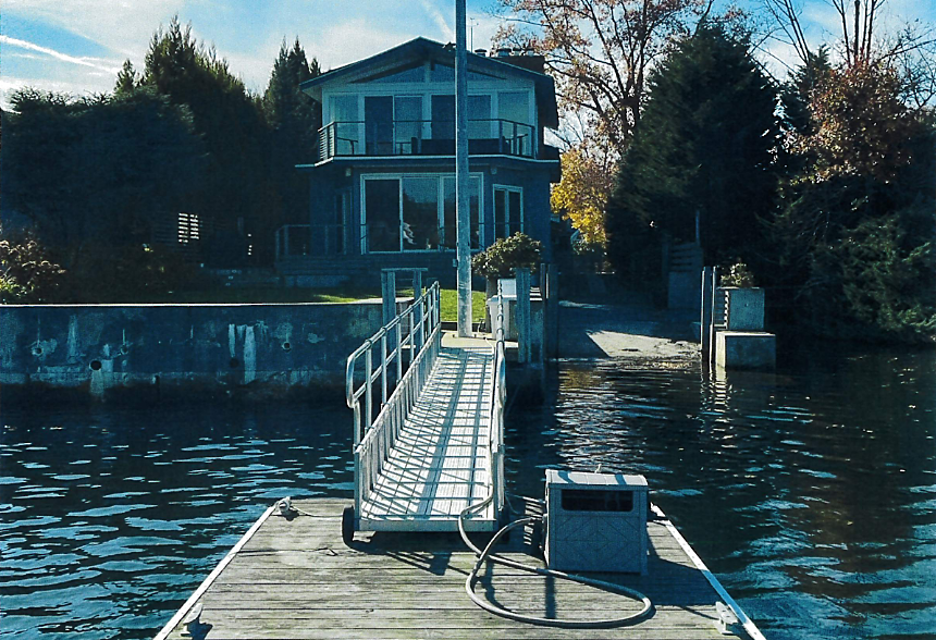
Another reason the ZBA gave for granting the variances was that the project will improve existing conditions due to a decrease in impermeable surfaces on the lot. Part of this reduction would result from converting an existing concrete boat ramp into a planted area and removing a small cement patio. Because that work does not require a variance, questions remain regarding how much credit the improvement on another portion of the property should carry in evaluating the requested setback relief.
Variances Must Be the Minimum Required
Another question arising out of the ZBA’s decision is whether the variance granted was the minimum necessary. Under NYS Village Law § 7‑712‑b, the ZBA is required to provide only the minimum variance necessary to address the benefit the applicant is seeking, while preserving neighborhood character and community welfare.
Because the homeowners did not explain why the specific amount of additional deck space was necessary, it is difficult to determine whether the approved variance represented the minimum relief called for under state law.
Five-Point Balancing Test
For each variance application, New York law also requires the ZBA to weigh the benefit to the applicant against any detriment to the health, safety, and welfare of the neighborhood or community by considering five statutory factors. See HERE.
In the case of 714 The Crescent, the ZBA’s public deliberations raised questions about how extensively each of the statutory factors was weighed, including consideration of:
· the neighboring homeowner’s concerns regarding the detriment to her property’s privacy and security,
· whether a ground-level patio could have provided a feasible alternative for additional outdoor space without requiring a variance,
· and whether approving such a large setback reduction could influence future applications for elevated structure requests, resulting in an adverse impact on Village neighborhoods and districts.
Incorrectly Applied Rules and Flood Issues
The review of this application began in September 2025 and stretched on for eight months for several reasons.
The applicant originally requested additional variances to enlarge the home, expand a second floor balcony, and add a set of exterior stairs in the minimum side yards. It also included a much deeper deck expansion into the backyard. See HERE. These requests were withdrawn due to information that brought to light by the next-door neighbor during the public hearing.
The neighbor pointed out that the expansion of the home would require a floor-area-ratio (FAR) variance which had not been previously identified. The neighbor also informed the ZBA that the original design of the enlarged deck on this coastal property extended past the lot’s ”mean high-water mark” in the backyard – an area where construction is prohibited without a variance.
During the public hearings, questions were also raised regarding the project’s flood plain compliance. The property is in a “VE Zone” designated by the Federal Emergency Management Agency (FEMA) as a Special Flood Hazard Area. See HERE.
Next Steps
The project now requires site plan approval and a Wetlands Permit from the Planning Board, a consistency determination with the Local Waterfront Revitalization Program (LWVP) from Harbor Coastal Zone Management Commission, and a Floodplain Development Permit from the Building Inspector.